
Safety Switch Keeps Tripping? How to Find the Culprit
It’s a cold July night in Perth, the oven’s preheating, the dryer’s running, someone flicks the bathroom heater on, and the house goes dark. You reset the switch in the board, it holds for ten seconds, then snaps off again. Reset, snap. Reset, snap.
“My safety switch keeps tripping” is one of the most common calls we get as Perth electricians, and here’s the part most people don’t expect: the switch is almost never the problem. It’s doing exactly what it was built to do, cutting power in a few milliseconds because electricity is leaking somewhere it shouldn’t be. The trick is finding where, and most of the time you can do that yourself in ten minutes, no tools required.
Key Takeaways
- A tripping safety switch (RCD) means electricity is leaking to earth somewhere, through a faulty appliance, moisture, or damaged wiring. It is not “just being sensitive”.
- The 10-minute diagnostic: unplug everything on the tripped circuit, reset, then plug appliances back in one at a time. The one that trips it is your culprit.
- Heating elements are the usual suspects, ovens, hotplates, dryers, hot water systems, dishwashers and bar heaters top the list, especially in winter.
- If the switch trips with everything unplugged, the fault is in the fixed wiring, that’s licensed-electrician territory, not a DIY hunt.
- Never hold the switch on, tape it, or bypass it. An RCD trips at around 30 milliamps of leakage precisely because that’s the threshold that saves lives.
First: which switch actually tripped?
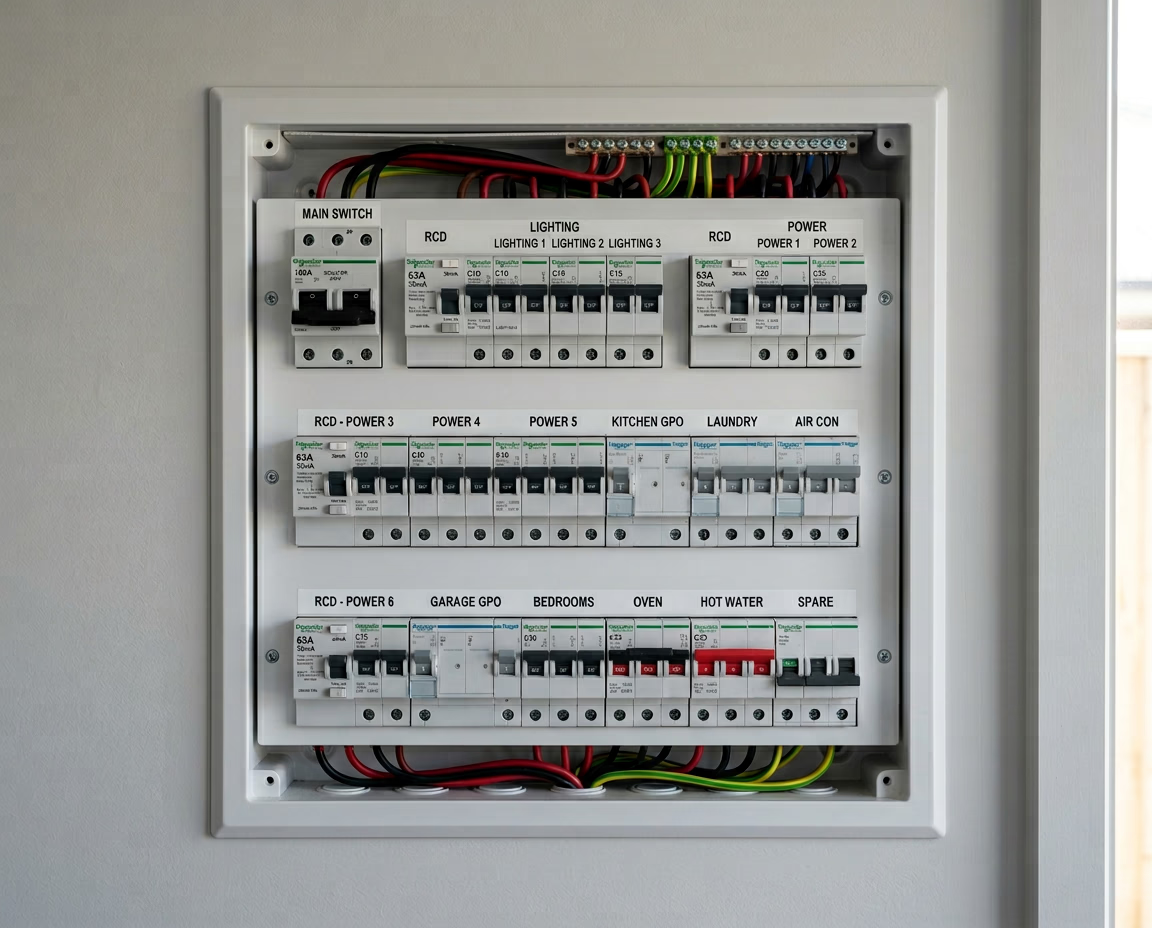
Open the switchboard and look at what’s fallen to OFF. They’re not all the same animal:
| Device | What it protects against | How to spot it |
|---|---|---|
| Safety switch (RCD) | Electricity leaking to earth, the electrocution risk | Has a TEST (T) button; one RCD usually covers several circuits |
| Circuit breaker | Overload and short circuit, too much current | No test button; one per circuit (lights, power, oven…) |
| RCBO | Both of the above in one unit | Test button, but protects a single circuit |
| Main switch | Whole-installation isolation | Labelled MAIN SWITCH |
This matters because the fix is different. A circuit breaker that trips when the heater, kettle and microwave run together is telling you the circuit is overloaded, spread the load, and if it keeps happening, the circuit needs attention. A safety switch tripping is never about using too many appliances at once, it’s about leakage, and leakage means a fault.
Why safety switches trip: the usual suspects
An RCD compares the current flowing out with the current coming back, and if the difference hits about 30 milliamps, a small fraction of what a toaster draws, but plenty to kill a person, it cuts the circuit in under a heartbeat. Something in your house is bleeding current to earth. In rough order of how often we find them:
- Heating elements, ovens, hotplates, clothes dryers, dishwashers, hot water systems, portable heaters. Elements absorb moisture and develop hairline cracks as they age; the leakage often only shows once the element heats up, which is why the oven trips the board 20 minutes into cooking, not the moment you switch it on.
- Moisture, rain in an outdoor power point or garden lighting, a leak dripping near wiring, condensation in a laundry or bathroom fitting. If the tripping started with Perth’s winter rain, this is where we’d look first.
- A failing appliance, fridges and freezers (defrost heaters again), washing machines, old power tools, cheap phone chargers. Anything with a motor or element degrades eventually.
- Damaged cables, a screw or nail through a wall cable, rodent damage in the roof, perished insulation in older homes.
- Cumulative leakage, every electronic device leaks a tiny, legal amount. Load one RCD up with enough of a modern household and it sits close to the threshold; one more marginal appliance tips it over. Common in homes where one or two RCDs protect everything, more on that below.
- A worn-out RCD, they’re mechanical devices and they do age. Genuinely the least common cause, and it’s diagnosed by elimination, not assumption.
The 10-minute diagnostic
No tools, no roof crawling. Do it in daylight if the lighting circuit is affected.
- Note which circuits are dead. The tripped RCD covers them; the labels in the board (if you’re lucky) tell you which power points are on it.
- Unplug everything on those circuits. Actually unplug, switched off at the wall isn’t enough, because appliances can leak through their neutral even when off. Don’t forget the hidden ones: fridge, freezer, dishwasher, washing machine, garage door opener, pond pump, the beer fridge.
- Reset the safety switch. Push it firmly to full OFF first, then to ON.
- If it holds: plug appliances back in one at a time, waiting a minute or two between each. When the switch snaps off, the last thing you plugged in is your culprit. Leave it unplugged and have it repaired or replaced, and if it’s a fixed appliance like an oven or hot water system, that repair is an electrician’s job.
- If it trips instantly with everything unplugged: stop. The leakage is in the fixed wiring or a hardwired fitting, and finding it takes test instruments and a licence. That’s a call to us, not a longer hunt.
A culprit that only trips things sometimes, the oven mid-roast, the dryer near the end of a cycle, the fridge overnight, is still a culprit. Intermittent leakage is early-stage failure; it gets worse, never better.
When it trips every time it rains
A safety switch that drops out during or after rain is pointing outside: garden lights, an outdoor power point with a cracked cover, the bore pump, shed wiring, festoon lights strung from the pergola. Water gets in, leakage begins, the RCD does its job. Unplug or isolate the outdoor gear and see if the pattern stops, then get the wet point found and sealed properly rather than living with a house that reboots every cold front.
When the problem is the switchboard itself
Some tripping problems are really capacity problems wearing a disguise:
- The whole house goes dark for one faulty appliance, because a single RCD protects everything. Modern practice puts more RCDs (or individual RCBOs) across the circuits, so one leaky dishwasher doesn’t take out the fridge, the alarm and the lights.
- The board still has ceramic fuses or no test buttons anywhere, pre-RCD hardware. WA law has required a minimum of two RCDs protecting power and lighting circuits when a home is sold or leased since 2009, and a fuse board offers a fraction of the protection.
- Trips are frequent, random and unexplained across different appliances, classic cumulative-leakage territory on an overloaded, under-divided board.
If any of that sounds like your switchboard, the fix that actually ends the cycle is bringing the board up to current standards, we’ve written a full guide to switchboard upgrades in Perth covering what’s involved, and our switchboard service handles the work itself.
What not to do
- Don’t hold or tape the switch on. You’re disabling the device that exists to stop electrocution while a known fault is live.
- Don’t reset it endlessly without diagnosing. Each trip is the same fault talking. Two resets to identify a pattern is sense; ten is denial.
- Don’t touch a switchboard that’s wet, buzzing, smells burnt or shows scorch marks. Step away and call an electrician, after hours if that’s what it takes. That’s an emergency, not a fault-finding exercise.
- Don’t press the TEST button as a fix. Test monthly by all means, it verifies the mechanism trips, but it neither diagnoses nor cures a leakage fault.
FAQ
Why does my safety switch trip at random times, even overnight?
Random-looking usually isn’t. Fridges and freezers run defrost heater cycles a few times a day, hot water systems reheat on their own schedule, and marginal elements leak only when hot. Overnight trips with everything “off” are classically the fridge, the hot water system, or moisture reaching outdoor wiring as the temperature drops.
The safety switch trips the moment I reset it. What now?
Everything unplugged and it still won’t hold? The fault is in fixed wiring or a hardwired appliance, and it needs instrument testing to isolate. Leave the affected circuits off and book an electrician, describe exactly what you’ve already unplugged and we can usually narrow it before arriving.
Can I replace a safety switch or RCD myself?
No, in WA, all work inside the switchboard must be done by a licensed electrical contractor. It’s also rarely the right diagnosis: a genuinely faulty RCD is the least common cause of repeated tripping, so replacing it usually buys a new switch that trips for the same old reason.
How much does it cost to fix?
Honest answer: it depends entirely on where the fault is. If your own 10-minute diagnostic finds a faulty kettle, it costs you a kettle. If it’s a fixed appliance, a wet outdoor fitting or a wiring fault, we quote the repair upfront after fault-finding, and if the real issue is an old, under-protected board, we’ll say so with a fixed price for the upgrade rather than billing repeat visits to a board that’s past it.
My power went out but the neighbours have power; is that a tripped switch?
Very likely, yes. Check your switchboard for anything dropped to OFF before ringing anyone. If the board looks normal and the whole house is dead, check whether the main switch or service fuse is the issue, and if nothing in the board explains it, that’s when you call an electrician or Western Power for a street-side fault.
The bottom line
A safety switch that keeps tripping is a working switch reporting a real fault: a leaky appliance, moisture in a fitting, damaged wiring, or a switchboard that’s carrying a modern household on decades-old protection. The unplug-and-reintroduce diagnostic finds the culprit in most homes in ten minutes. Trips with everything unplugged, trips linked to rain, or a board with one RCD doing all the work, those are the ones to hand to a licensed electrician.
Tripping sorted by a licensed Perth electrician
We fault-find tripping RCDs across Perth with proper test instruments, usually in a single visit, and as a dual-licensed electrical and air conditioning contractor we can test the suspect appliances while we’re at it. If the board needs bringing up to standard, you’ll get a fixed upfront price, not a mystery.
Book a fault-finding visit or call 0434 951 341, and if the board is wet, burnt-smelling or buzzing, call now rather than business hours.
Need a hand with this?
Otter Air is your local, licensed Perth team for air conditioning and electrical. Free quotes, upfront fixed pricing, and honest advice.