
Ducted Air Conditioning Cost Perth: $8k–$22k
Last December, a customer in Forrestfield called us in a panic. Two splits running flat-out, the kids’ bedrooms still 28°C at midnight, and a $13,500 ducted quote sitting on the kitchen bench that “didn’t include” the $500 switchboard upgrade he’d need on top. He wanted to know: was the quote fair, was the switchboard thing real, and would ducted actually fix his problem?
Two of those three answers turned out to be straightforward. The third needed a closer look at his house. This guide to ducted air conditioning in Perth walks through the same conversations we have at every free quote, minus the sales pitch: real costs, zoning, the switchboard question, and how to read a quote properly.
Key Takeaways
- Ducted reverse cycle starts around $8,000 for smaller homes and runs to $22,000+ for larger ones, most Perth installs land $12,000–$15,000.
- Switchboard upgrades are sometimes worth doing, budget anywhere from $500 to $4,000 depending on what’s actually required versus what you’d like upgraded for peace of mind.
- Single-phase power covers it for almost every home, residential ducted up to 18kW runs fine on single-phase. 3-phase is rarely needed.
- Zoning is the make-or-break feature. A 3-zone system cooling only the rooms you’re in often runs cheaper than two splits going at once.
- Install is a one-day job in most homes, book 4–6 weeks ahead if you’re scheduling around the busy season (Oct–Jan).
Quick note before you read on: if you just want a real number for your specific house, book a free site visit, we’ll check your switchboard, measure the rooms, and quote the whole job (electrical + AC) in one number.
What ducted reverse cycle actually is
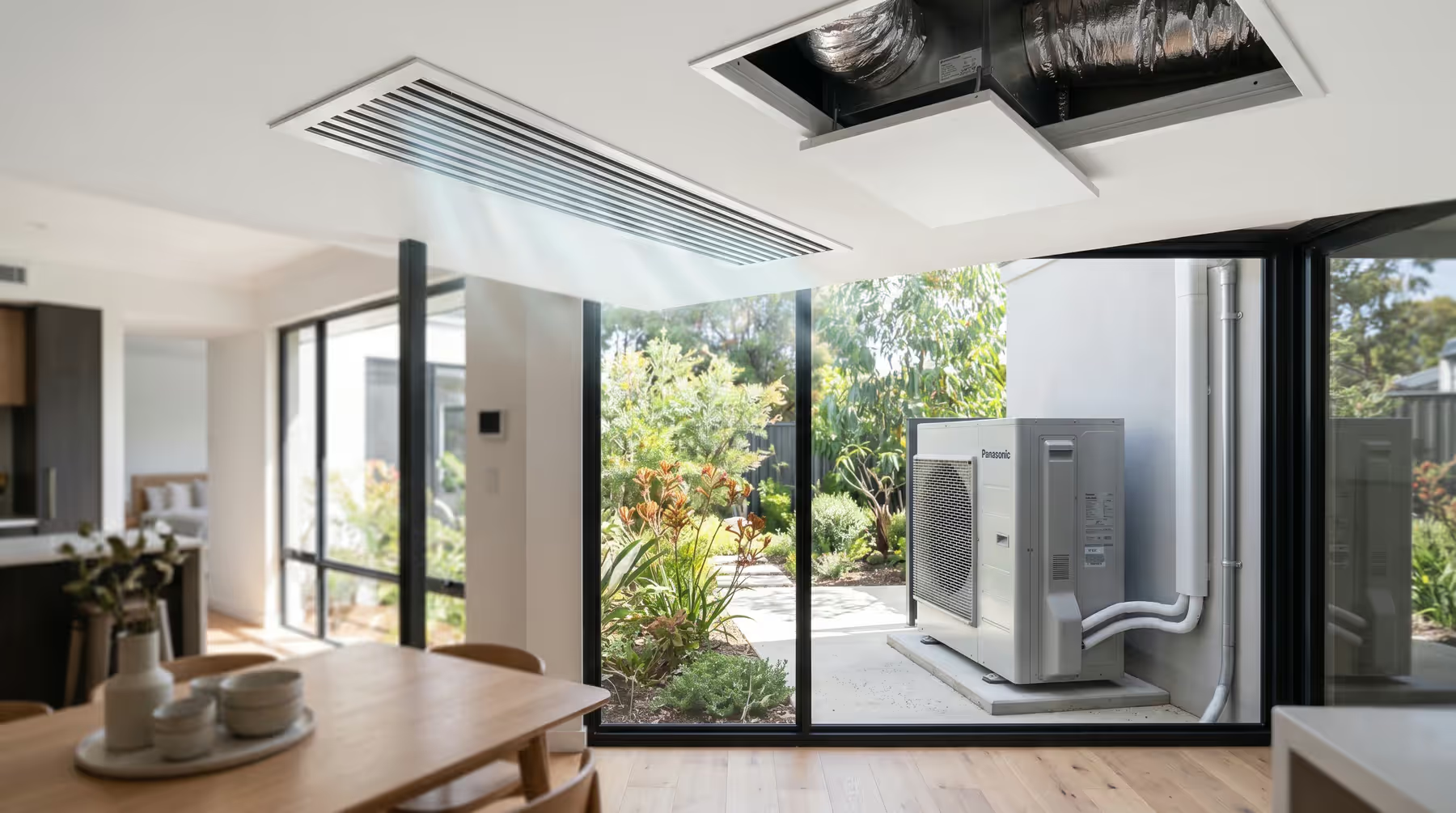
Ducted reverse cycle is one outdoor compressor that pushes refrigerant through copper pipes to an indoor fan coil (usually mounted in the ceiling space). Insulated flexible ducts run from that fan coil to vents in each room. A zoning controller lets you turn rooms on and off independently.
“Reverse cycle” means it both cools and heats, which matters more than people think in Perth. The seven weeks from mid-July through early September are genuinely cold once your house cools down overnight, and reverse cycle is one of the cheapest ways to heat a whole home, especially if you have solar.
The system has four main parts you’ll see on every quote:
- Outdoor unit (the compressor), usually mounted on a concrete slab on the side of the house. About the size of a medium fridge.
- Indoor unit (the fan coil), lives in the ceiling cavity, generally somewhere central. Roughly the size of three or four filing cabinets stacked together.
- Ductwork + vents, insulated flexible ducts running through the roof space to ceiling vents in each room.
- Wall controller, the touchscreen you actually use day-to-day. Sets temperature, picks zones, runs schedules. Worth paying attention to at quote time because it’s the part of the system you’ll interact with every day.
That’s the whole picture. Everything else on a quote is supporting work: electrical connections, refrigerant pipework, condensate drainage, controller wiring. (For a plain-English rundown of the system and what’s involved, see our ducted air conditioning installation page.)
When ducted makes sense (and when splits are better)
The honest answer is: ducted isn’t always the right pick. We quote about 50% of Perth homes for ducted and 50% for splits, depending on the house. If you’re weighing up both options, our split system vs ducted air conditioning comparison breaks the decision down side by side.
Ducted makes sense when:
- You’d otherwise install three or more split units. Once you’re at three splits, the visual clutter, running cost, and warranty management start to favour one ducted system.
- You’re building new or renovating a home with no roof cavity. Most existing Perth homes have plenty of ceiling space, so retrofit and during-construction installs cost about the same. The exception is flat-roof or skillion-roof homes, if there’s no ceiling cavity, ducts have to go in during the build.
- You want quiet, even cooling. Splits blow concentrated air from one corner. Ducted spreads it through the whole room from above, with the noise contained to the outdoor unit and the ceiling cavity.
- Your home has decent ceiling space for ductwork. Most brick Perth homes do. Some 1950s–1960s flat-roof homes don’t.
- You’re planning to stay in the house at least 5–7 years. Ducted adds real resale value but it’s a significant upfront spend.
Splits make more sense when:
- You only cool one or two rooms regularly.
- The house has no roof cavity access (some renovated homes).
- The budget genuinely can’t stretch to $14k+ and zone-by-zone splits get you 80% of the comfort for 30% of the price.
- It’s a rental property, splits are easier to remove and replace if a tenant complains.
Last winter, we quoted a young couple in Bayswater. They had a 3-bedroom timber-frame cottage and assumed they wanted ducted because their friends had it. Walked their house, looked at the ceiling space (limited because of the timber-frame structure), checked their usage pattern (mostly just the main living area and the master bedroom). Recommended two splits, total install $5,800, instead of $12k ducted. They went with the split system install. Six months later they messaged to say the running cost on their power bill went up by less than $30/month. That’s the right call when the right call is splits.
What ducted air conditioning actually costs in Perth (2026 numbers)
Real ranges, broken down by what changes the number. These are install-included, GST-included Perth metro prices as of mid-2026.
Base install costs by home size
| Home type | System size | Zones | Typical install range |
|---|---|---|---|
| Small / townhouse / 2 bedroom | 7–10kW | 2–3 zones | $8,000–$11,000 |
| 3 bedroom single-storey | 10–14kW | 3 zones | $11,000–$14,500 |
| 4 bedroom standard family home | 14–16kW | 4 zones | $12,500–$16,000 |
| 4 bedroom two-storey | 16–18kW | 5 zones | $15,000–$20,000 |
| Larger (300m²+) executive home | 18kW+ | 5–7 zones | $18,000–$25,000+ |
Most Perth ducted installs land in the $12,000–$15,000 band, that’s the realistic number to budget for unless your home is either notably small or notably large.
What pushes the price up
Most “from $14,995” advertised prices are real numbers for a real house, just not your house. The variables that matter:
- Switchboard upgrade ($500–$4,000), wide range because it really depends what’s required versus what you’d like done. A simple safety-switch retrofit at the lower end; a full board replacement with RCBOs at the upper end. We cover this in detail in our switchboard upgrade guide.
- Long pipe runs (+$500–$1,500), when the outdoor unit has to sit a long way from the indoor unit. Adds refrigerant and labour.
- Premium brand uplift (+$1,500–$3,500), going from a value brand (Midea) to a premium brand (Panasonic, Daikin) in the same kW class.
What keeps the price down
- Single-storey, decent roof access, most Perth homes fit this. Standard install.
- Recent switchboard, anything installed since 2010 is usually fine for a ducted load.
- Quoted in autumn (April–June) or late winter (July–August), installers’ calendars are less crammed, so we can sometimes price more keenly outside peak install season.
So a small ducted job in a townhouse can land as low as $8,000–$9,000. A standard 4-bedroom Perth home, no switchboard work needed, comes in around $13,000–$14,500. The number scales up from there depending on which of the “what pushes the price up” variables apply.
How much is ducted air conditioning for a 4-bedroom house?
The question we get more than any other, so here it is on its own. For a standard single-storey 4-bedroom Perth home, budget $12,500–$16,000 supplied and installed, most land around $13,000–$14,500 when no switchboard work is needed. A two-storey 4-bedroom home runs $15,000–$20,000 because of the extra duct runs and access time. Those figures cover a properly sized 14–16kW system, 4 zones, the electrical work and GST. One caution: west-facing living areas or a master bedroom that cops the afternoon sun can push you to the top of the size range, and it’s worth sizing for that rather than saving a few hundred dollars on a smaller unit that runs flat-out every January.
Reverse cycle ducted air conditioning prices at a glance
Every price in this guide is for reverse cycle ducted air conditioning, one system that cools in summer and heats in winter. As a quick recap of Perth reverse-cycle prices: small homes and townhouses $8,000–$11,000, a 3-bedroom single-storey $11,000–$14,500, a 4-bedroom family home $12,500–$16,000, and large executive homes $18,000–$25,000+. Cooling-only ducted has all but disappeared from the residential market, and the price difference is negligible anyway, there’s no meaningful saving in giving up heating.
Why zoning is the feature that matters most
This is the part most quotes don’t explain well. Zoning is what makes ducted economically sensible versus running three or four splits.
A 5-zone ducted system controlling 5 rooms doesn’t try to cool all five rooms at once. You select which zones are on (typically Living + Kitchen during the day, then Bedrooms at night) and the system only directs air to those zones. The outdoor unit modulates down accordingly, a properly-sized inverter compressor will draw 1.5–2.5kW running, not its full nameplate rating.
The practical effect: a 14kW ducted system running 3 zones during peak Perth summer pulls roughly the same power as one 7kW split working hard. If you’d otherwise run 2–3 splits to cool the same rooms, ducted is the cheaper option to run, not the more expensive one.
There’s a customer in Forrestfield (the same one from the intro) who messaged us four months after his install. His January power bill was $480, against a previous January with two splits at $620. That’s not a fluke, properly-sized, properly-zoned ducted nearly always beats multi-split running costs in Perth’s climate.
The catch: this requires correct zone design. A quote that doesn’t ask which rooms you actually use is one that probably hasn’t planned the zones properly.
Worth checking before you sign anything: ask your installer how they decided on the zone configuration for your house, and which rooms are grouped together. A good installer will have a clear answer involving how you actually live in the house.
The electrical side most installers ignore
Ducted air conditioning is electrical work as much as it is HVAC work. The system needs:
- A dedicated circuit from the switchboard to the outdoor unit (typically 20–32 amp, depending on system size).
- Safety switch protection on that circuit (RCD or RCBO).
- Proper isolator within sight of the outdoor unit (an electrical safety requirement under AS/NZS 3000, the Wiring Rules).
- Sometimes switchboard space for the new breaker, and many older Perth switchboards are already at capacity.
Some older Perth homes benefit from at least a partial switchboard upgrade before a ducted system goes in. The signs:
- Ceramic fuses instead of circuit breakers
- No safety switches (RCDs) on existing circuits
- Switchboard already has all positions filled
- Mains supply that’s struggling under existing loads
When a pure-HVAC installer quotes ducted on a house like this, the “your switchboard needs upgrading” surprise can land as a separate quote from a sparky a few days before install, which pushes the job back while you book a second tradie.
This is where dual-licensed installers earn their keep. Otter Air is licensed for both refrigeration work (ARC) and electrical (WA EW licence), so we cover the switchboard, the dedicated circuit, the isolator, the safety switch, and the ducted system in one quote, on one timeline, with one warranty. No hand-offs, no two-week scheduling delay, no surprise bill.
See how we handle switchboard work →
What a ducted air conditioning install actually looks like
99% of ducted installs in existing Perth homes are completed in a single day. Two installers, one full day on site. Here’s the sequence:
Morning:
- Outdoor unit positioned and mounted on a concrete slab.
- Indoor fan coil positioned in the roof cavity (somewhere central).
- Refrigerant copper pipes run between the two.
- Dedicated power circuit run from switchboard to outdoor unit isolator.
Midday:
- Insulated flexible ducts run from the indoor unit out to each room.
- Ceiling vents cut and installed, with grilles fitted.
- Condensate drain plumbed to outside.
- Zone motors and wiring installed in the ceiling cavity.
Afternoon:
- System pressure-tested and charged with refrigerant to manufacturer spec.
- Wall controller mounted, wired, paired, and programmed with your zone setup.
- Full performance test under load.
- Walkthrough, how to use the controller, set zones, and run schedules.
- Compliance paperwork signed off.
Larger jobs (big homes, 6+ zones) or new-build installs run alongside other trades and can stretch over two days, but the everyday Perth retrofit is in, working, and cleaned up before dinner.
How to read a ducted air conditioning quote
This is the part that saves you the most money long-term. A good quote will clearly itemise:
- System, make, model, kW capacity, indoor + outdoor unit references.
- Zones, how many, which rooms in each zone, what controller.
- Ductwork, length and diameter, insulation grade.
- Electrical works, switchboard work (if any), dedicated circuit, isolator, safety switch.
- Compliance, certificate of electrical compliance.
- Warranty, manufacturer warranty (usually 5 years on the unit) AND workmanship warranty (industry standard is 12 months; Otter Air offers 5 years).
- What’s NOT included, make this explicit. Plastering or patching after ducts go in? Removal of the old system? Any reinstating of insulation that gets disturbed?
Red flags on a quote:
- “From $X” pricing, they haven’t actually quoted your house.
- No electrical work listed, they’re either ignoring it (problem on install day) or expecting you to organise it separately.
- No mention of zones or vague zone description, suggests cookie-cutter quoting rather than a real walkthrough.
- “All inclusive” with no breakdown, you have no way to challenge specific line items.
- No workmanship warranty stated, every reputable installer will commit to one in writing.
We had a customer in Atwell last September show us three competing quotes for ducted. The cheapest looked great at $11,500, until we walked her through it. They’d quoted a 10kW system for a four-bedroom home that actually needs 14kW (the lounge and master both face west and her existing splits were always under-coping). They’d also quoted 3 zones instead of the 5 her layout really needs, so she’d be heating empty rooms every time she ran it. By the time she’d asked for a properly-sized system with the right zone count, the cheap quote was sitting at $15,200, basically the same as ours, but with no five-year workmanship warranty. She went with us. That’s not a sales story, that’s the actual industry pattern, cheap quotes look cheap until you check what’s been left off.
Brands we install (and how to choose)
We’re not aligned with any single manufacturer, we install what’s right for your house and budget. The brands we install most often:
- Panasonic, our top pick. Premium quality (in our experience on par with Daikin), at a sharper price thanks to our supplier relationship, and the only brand offering nanoeX air purification in its ducted range. Suits most of the homes we quote.
- Daikin, also premium. Market-leading reliability at a premium price. A great call if you want top-tier and budget allows.
- Mitsubishi Electric, close to Daikin on quality, slightly quieter operation, slightly cheaper.
- Midea (including Athena series), value-tier brand that’s rapidly improved over the last 5 years. Genuinely competitive with mid-market brands at 70–80% of the price.
If you have a specific brand preference outside of these, we can source and install pretty much any major brand, just mention it at the quote. We’re not commission-tied to any single manufacturer. You can also browse our range of air conditioners to get a feel for the systems we supply.
The general guidance for most homeowners: Panasonic is the safe, sensible default. Daikin or Mitsubishi Electric if you want premium. Midea Athena if budget’s tight and you still want a current-generation inverter system. Avoid anything you’ve never heard of, the warranty network matters more than the brochure features.
Read more about our installation approach →
Finance options for the upfront cost
A $12,000–$15,000 install is still a significant spend. Most customers either pay outright or use a payment plan through Handypay, a third-party finance provider we can refer you to (they assess and provide the finance, not us).
The maths usually works out: monthly payment on a 24–36 month plan is often less than the difference between the old system’s running cost and the new one’s. For homes replacing 4–5-year-old splits or evaporative systems with new ducted reverse cycle, the running cost saving partially funds the install over its first 3–4 years.
See Handypay’s payment plan options →
Frequently Asked Questions
How much does ducted air conditioning cost to run in Perth?
A 14kW ducted system running 3 zones for 8 hours during a Perth summer day costs roughly $4–$6 in electricity. The total monthly summer bill increase versus baseline tends to be $80–$140 for a typical 4-bedroom home, depending on usage and tariff.
Do I need three-phase power for ducted air conditioning?
Almost never. Residential ducted systems up to 18kW run fine on single-phase supply. In 10 years of installing ducted across Perth we’ve only needed three-phase once, and that home already had three-phase wired in. If your home is large enough that one ducted system can’t cover it, two ducted systems running off single-phase is usually a better option than upgrading the whole house to three-phase.
How long does a ducted air conditioning system last?
Properly maintained, expect 12–18 years from a quality system. Components vary, fan motors and capacitors are usually the first to fail (around year 10–12), and compressor failure is the typical end-of-life event around year 15.
What size ducted system do I need for my Perth home?
A rough rule for Perth’s climate: 140–160W per square metre of conditioned space. A 200m² home typically needs 14–16kW. Proper sizing requires a load calculation considering insulation, window orientation, room usage, and ceiling height, which is part of every Otter Air quote.
Can ducted air conditioning be added to an existing home?
Yes, in nearly all Perth homes. The main exception is homes with no roof cavity, that includes some flat-roof 1950s–1960s homes and the more modern flat-roof/skillion-roof builds you see in new estates. If your roof has a cavity you can stand up in, retrofitting ducted is straightforward. We can tell you definitively after a 30-minute site visit.
Is ducted reverse cycle expensive to heat with in winter?
Not particularly. Reverse cycle is significantly more efficient than electric resistance heating (panel heaters, oil column heaters), usually 3–4× more efficient. The Australian Government’s energy. gov. au heating and cooling guide rates modern reverse cycle systems at 300 to 600% efficiency, because they move heat rather than generate it. Versus gas, it’s a closer call: gas can be cheaper on some tariff/usage combinations, while reverse cycle wins outright if you have solar (and especially if you have a battery). Most Perth homes find the winter running cost manageable.
The bottom line
Ducted air conditioning in Perth in 2026 starts around $8,000 for smaller homes, lands $12,000–$15,000 for a typical 4-bedroom install, and runs to $22,000+ for larger executive homes. Switchboard upgrades, when they’re worth doing, add anywhere from $500 to $4,000 depending on scope. It’s the right choice for homeowners cooling three or more rooms regularly, planning to stay in the house 5+ years, and wanting quiet, even, zoned comfort.
It’s not the right choice for everyone, and a good installer will tell you that. If splits suit your house better, we’ll tell you so.
Ready to know what your house would cost?
We’ll come out, walk through your home, check your switchboard, and quote the whole job, air conditioning + electrical works + compliance, in one number. Free and no-obligation. Most quotes are turned around within 24 hours of the site visit.
Get your free Perth ducted air conditioning quote →
Or if you’ve got a quote already and want a second opinion, we’re happy to look at what’s been proposed. No charge.
Written by Matt Grossmith, owner of Otter Air & Electrical. Matt is ARC-licensed for refrigerant work and holds a WA EW electrical contractor’s licence. 10+ years installing and servicing residential air conditioning across Perth.
Need a hand with this?
Otter Air is your local, licensed Perth team for air conditioning and electrical. Free quotes, upfront fixed pricing, and honest advice.