

Best Home EV Charger Australia: 2026 Picks
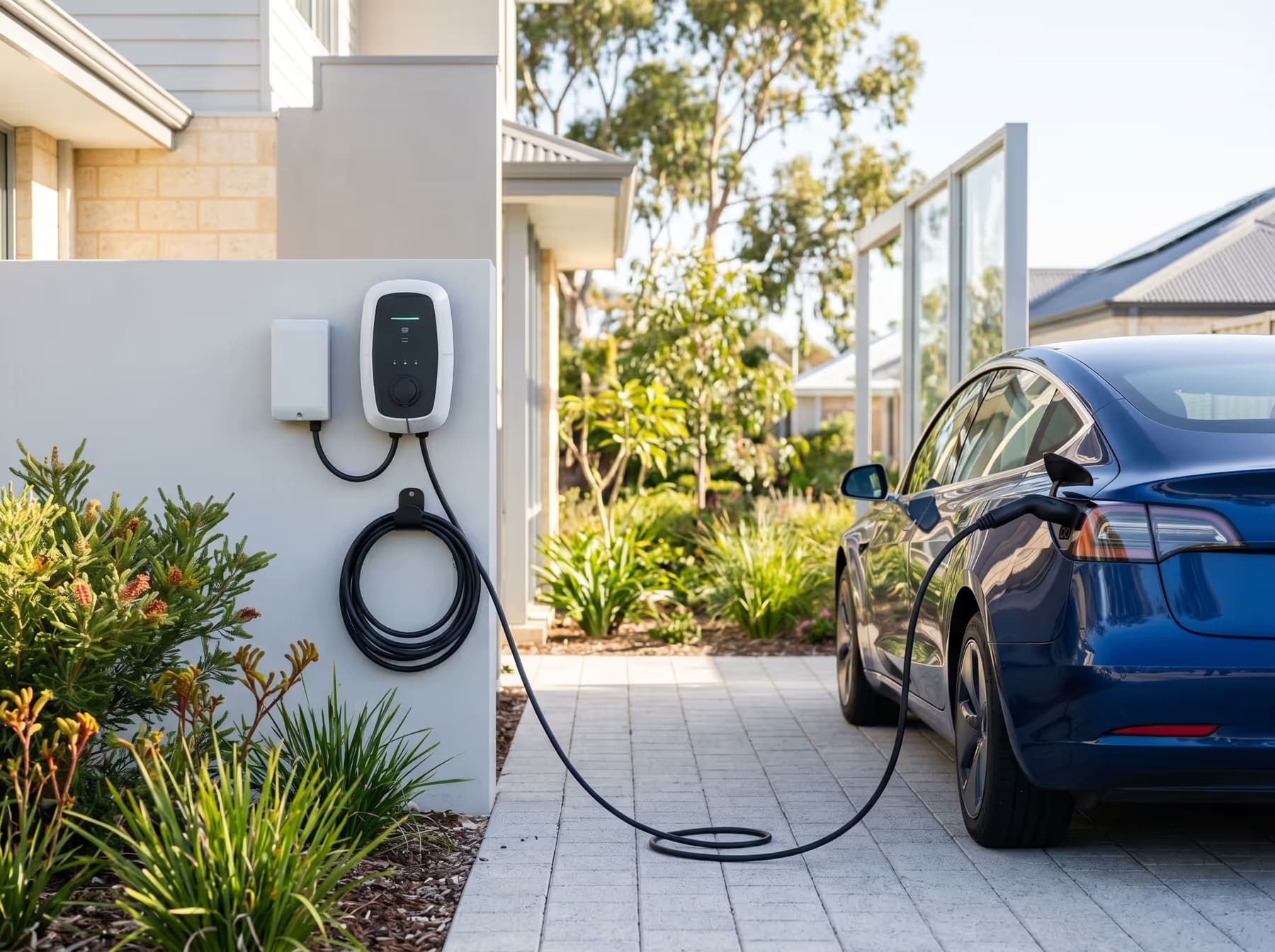
We install EV chargers for a living, and here’s the thing nobody selling them will tell you: the difference between a good home charger and a mediocre one has almost nothing to do with charging speed. Nearly every 7kW charger on the Australian market charges your car at the same rate. What separates them is the software, the solar smarts, the warranty, and whether the thing still works flawlessly three summers from now on a 40-degree Perth wall.
This guide ranks the best home EV charger Australia has to offer in 2026 from an installer’s point of view: the units we fit, the units customers ask us to fit, and where each one genuinely wins. One thing to declare upfront so you can weigh my opinion properly: we’re an Evnex installer, and you’ll see why they top the list. But if a Tesla Wall Connector or a Zappi is the right call for your setup, that’s what this guide will tell you. If you just want prices and a booking, our EV charger installation page has fixed installed prices.
Key Takeaways
- Best overall: Evnex E2 Flex. A 7.4kW single-phase smart charger designed for Australian and NZ conditions, solid app, solar-upgradeable later. From $1,410 inc GST installed.
- Best for solar homes: Evnex E2 Core (built-in solar diversion and tariff-based charging, from $1,680 installed) with the myenergi Zappi as the well-known alternative.
- Best for Tesla owners: Tesla Wall Connector, if you live in the Tesla app anyway, nothing integrates more cleanly.
- Best three-phase: Evnex X22, up to 22kW for homes that already have three-phase supply. From $2,850 installed.
- 7.4kW single-phase is the sweet spot for almost every Australian home: it fully recharges most EVs overnight, and most homes are single-phase anyway.
Already know what you want? Get a fixed installed price from a licensed Perth electrician, free, no call-out fee.
How an installer judges a home EV charger
Anyone can compare spec sheets. After a few years of installing and living with these units, we weight five things:
- Reliability on Australian supply. Chargers run 32 amps continuously for hours in roof-radiated garage heat. Units engineered for this part of the world hold up better than grey imports.
- The app. You’ll touch the app far more than the charger. Scheduling, charge limits, cost tracking, and whether it still connects reliably a year in.
- Solar integration. If you have panels (or will), solar diversion is the single feature that changes your running cost the most.
- Warranty and local support. A charger with an Australian or NZ support line and a straightforward warranty process beats a cheaper unit with an overseas email address.
- Installed price. The sticker price means little; what matters is the number after a compliant install with a dedicated circuit.
Best overall: Evnex E2 Flex
The E2 Flex is what we fit most, and what I’d put on my own wall. Evnex is a New Zealand company that designs its chargers specifically for Australian and NZ grids and conditions, and it shows in the details: a 7.4kW single-phase unit with a 5m tethered cable, scheduling and charge tracking through the Evnex app, and (the underrated part) a clean upgrade path, the same hardware platform can be upgraded to solar diversion later, so buying the Flex now doesn’t lock you out of solar smarts when you add panels.
Evnex backs it with local support, and in our experience the units just quietly work, which is the highest compliment an installer can pay. From $1,410 inc GST supplied and installed by us, dedicated circuit and Western Power notification included.
Choose it if: you want a quality smart charger at the sharpest installed price and you don’t have solar yet.
Best for solar homes: Evnex E2 Core (and the Zappi)
The E2 Core is the Flex with the solar brain switched on: built-in solar diversion (it watches your export and pushes excess solar into the car instead of the grid) plus tariff-based charging that automatically favours your cheapest electricity hours. If you have panels, this is the feature that takes your per-kilometre cost toward zero, and it’s why the Core is worth the step up. From $1,680 inc GST installed.
The best-known alternative is the myenergi Zappi, the charger that made solar diversion famous. It’s a genuinely good unit with a loyal following and it does the same core trick well. myenergi quotes its own eco modes and per-watt tracking, and if you already run myenergi gear it’s a natural fit. We’re happy to install one you’ve bought. Between the two on a fresh purchase, we lean Evnex: comparable solar smarts, a cleaner app in our experience, and a sharper installed price through our supply line.
Choose the Core (or a Zappi) if: you have solar now. The maths is compelling, and we ran it in our EV charger running-cost guide.
Best for Tesla owners: Tesla Wall Connector
If your household is all-Tesla and you live in the Tesla app, the Wall Connector is hard to argue with: it’s tidy, reliable, and the integration with the car (charge scheduling, tracking, everything in one app) is seamless in the way only a closed ecosystem can be. Tesla states it also charges other EVs via its Type 2 connector, though you give up the app integration that’s the main reason to buy it.
What you don’t get is solar diversion; Tesla’s charging smarts assume a Powerwall does that job. Buy it from Tesla at current retail, and we’ll install it from $650 inc GST on a dedicated circuit with the compliance paperwork done.
Choose it if: you drive a Tesla, you don’t need solar diversion, or you have a Powerwall doing that work already.
Best three-phase: Evnex X22
Most homes don’t need this, and that’s fine. But if your home already has three-phase supply, the X22 delivers up to 22kW, roughly 120km of range per hour, with the same Evnex app and solar smarts as the E2 range. It’s the difference between an overnight charge and a top-up while you eat dinner. From $2,850 inc GST installed.
One honest caution from the quoting side: don’t upgrade your home to three-phase just for faster EV charging. A 7.4kW single-phase charger fills most EVs overnight, and the supply upgrade money is better spent elsewhere. If you already have three-phase (some newer builds and larger homes do), the X22 makes the most of it.
Choose it if: you already have three-phase power and want the fastest possible home charging.
Also worth a look
- Wallbox Pulsar Max: a compact, well-regarded Spanish unit with a slick app. A solid choice, though local support depth is where the local brands win.
- Fronius Wattpilot: the natural pick if you already have a Fronius solar inverter; Fronius designed it to pair with its own ecosystem for solar charging.
We’re brand-independent on installs: if you’ve bought any of these (or something else), install-only starts at $650 and the job gets the same dedicated circuit, load management and Western Power notification as a supplied unit. Full details on our EV charging service page.
Solar EV charging: the feature worth paying for
The question behind the question, because “which charger is best” usually turns out to mean “which charger makes charging cheapest”. If you have solar panels, an EV charger with solar diversion changes the economics completely: instead of exporting your excess solar for a few cents, the charger redirects it into the car. On a sunny Perth day a parked EV becomes the most profitable place your solar can go, and your per-kilometre cost heads toward zero.
Three things to know before you buy on this feature:
- You need the charger to support it natively (E2 Core, Zappi, Wattpilot) or to integrate with your existing energy ecosystem (Tesla with Powerwall). It can’t be bolted onto a basic charger later, with the exception of upgradeable platforms like the Evnex E2 range.
- Single-phase is fine. Solar diversion works on ordinary single-phase homes; you don’t need three-phase or a battery.
- The car needs to be home in daylight for solar charging to matter. If the car is at work every weekday, tariff-based overnight charging (which the E2 Core also does) will save you more than solar diversion will.
What about cheap chargers and the cable in the boot?
The portable charger that came with your car (a “granny charger”) plugs into a normal powerpoint and adds roughly 10 to 15km of range per hour. As a backup, it’s fine. As your only charger, it means a 400km battery takes more than a full day to fill, and a standard powerpoint circuit was never designed for that duty cycle day in, day out.
Cheap no-name wall chargers are the other trap: the sticker saves you a few hundred dollars, and then you discover the app is abandoned, the warranty path leads overseas, and the unit derates in summer heat. The charger is the cheap part of the system; the install, the circuit and ten years of daily use are the expensive part. Put the quality where the duty is.
The buying checklist
Five questions that sort out the right charger faster than any spec sheet:
- Single-phase or three-phase supply? Check your switchboard or ask us; it decides half your shortlist. (Older boards sometimes need work for any charger; our switchboard upgrade guide covers what that costs.)
- Do you have solar, or plan to add it? Yes: solar diversion (E2 Core, Zappi) or an upgradeable platform (E2 Flex). No: a quality smart charger is enough.
- Tethered or socket? Tethered (cable attached) is more convenient day to day; socket means bring-your-own cable but a tidier wall. Most of our customers pick tethered.
- Whose app do you want to live in? Tesla households: Wall Connector. Everyone else: judge the app as harshly as the hardware.
- Who’s installing it, and what’s included? A compliant install is a dedicated 32A circuit, correctly rated protection, load management, and Western Power notification for chargers over 20A. If a quote doesn’t mention those, it isn’t a complete quote.
Frequently asked questions
What is the best home EV charger in Australia?
For most homes, a 7.4kW single-phase smart charger, and our pick is the Evnex E2 Flex: designed for Australian and NZ conditions, good app, solar-upgradeable, from $1,410 inc GST installed. Solar homes should step up to the Evnex E2 Core or a myenergi Zappi for solar diversion; all-Tesla households are best served by the Tesla Wall Connector.
Is a 7kW charger enough for home?
Yes, for almost everyone. A 7.4kW charger adds roughly 40 to 50km of range per hour, which fully recharges most EVs overnight. Faster home charging only matters if you regularly need a fast turnaround and already have three-phase supply.
Do I need three-phase power for a home EV charger?
No. Most Australian homes are single-phase and a 7.4kW single-phase charger suits them perfectly. Three-phase enables 11 to 22kW charging (like the Evnex X22), but it’s only worth pursuing if your home already has three-phase supply.
Can I install an EV charger myself?
No. In WA (and everywhere in Australia) a hardwired EV charger is licensed electrical work: it needs a dedicated circuit, correctly rated protection at the switchboard, and chargers over 20A must be notified to Western Power. DIY electrical work is illegal and voids insurance. Buy the charger yourself if you like; from $650 inc GST we’ll install it compliantly.
How much does EV charger installation cost?
Install-only from $650 inc GST for a single-phase unit fitted near the switchboard. Supply and install from $1,410 inc GST for the Evnex E2 Flex, $1,680 for the solar-smart E2 Core, and $2,850 for the three-phase X22. The full breakdown, including what moves the price, is in our EV charger installation cost guide.
The bottom line
The best home EV charger in Australia for most people in 2026 is a 7.4kW single-phase smart charger, and the Evnex E2 Flex is our pick of them: right price, right features, engineered for this corner of the world. Solar homes should buy the solar brain (E2 Core or Zappi) because diversion is the feature that actually changes your bills. Tesla loyalists already know what they’re buying. And whatever you choose, the install matters as much as the unit: a dedicated circuit, proper protection, and the Western Power paperwork done right.
Want it on your wall?
We supply and install Evnex chargers across Perth at fixed prices, and we’ll happily fit a charger you’ve bought elsewhere from $650. Free fixed-price quotes, no call-out fee, and you deal with the same licensed electrician from quote to commissioning. See our fixed EV charger prices, or see what Perth homeowners say before you book.
Written by Matt Grossmith, owner of Otter Air & Electrical. Matt holds a WA EW electrical contractor’s licence and installs EV chargers across the Perth metro. Product specifications referenced are as published by Evnex, Tesla, myenergi, Wallbox and Fronius; installed prices are Otter Air’s own and include GST.
Need a hand with this?
Otter Air is your local, licensed Perth team for air conditioning and electrical. Free quotes, upfront fixed pricing, and honest advice.