
Switchboard Upgrade Cost Perth: $500–$4,500
Last winter a customer in Bayswater rang us in a state. Her ducted air con installer had just told her the existing switchboard wouldn’t pass the new install, quoted her $3,800 for a “full upgrade”, and said the AC job couldn’t go ahead until it was sorted. Was the switchboard upgrade actually needed? Was $3,800 fair? Or was she being shaken down?
Half the switchboard upgrades quoted in Perth are genuinely needed. The other half range from “would be nice but you can wait” to flat-out unnecessary. This guide walks through what your switchboard is actually doing, when a switchboard upgrade in Perth really is needed, what the work should cost in 2026, and how to spot the difference between a fair quote and a padded one.
Key Takeaways
- Switchboard upgrades in Perth start around $500 and run to $4,500+ depending on scope. A safety-switch retrofit is ~$500, a partial upgrade ~$1,000, a full board replacement $2,000-$4,500+ depending on size.
- You probably DON’T need an upgrade just because your switchboard “looks old”. The board still works mechanically for decades.
- You DO need one if: there are no safety switches (RCDs) on power and lighting circuits, you have ceramic fuses with no upgrade path, the board has run out of space for a new circuit, or it’s physically damaged or burnt.
- Three-phase boards always cost more than single-phase, bigger switches, larger enclosure, pricier RCDs. Expect 30-50% more for the same scope.
- A safety switch and an RCBO do different things, knowing the difference will save you money on the quote.
If you just want a real number for your specific board, book a free site inspection. We’ll open the board, tell you exactly what’s there, and quote only what’s actually needed.
What a switchboard actually does
Your switchboard is the box (usually on an outside wall, sometimes in a garage or laundry) that takes the main supply from Western Power and splits it across the circuits in your house. Lights, power points, the oven, the hot water, the air con, each gets its own circuit, fed off a switch on the board.
Three things happen at the board:
- Distribution, splits one big supply into many smaller circuits.
- Protection, trips a circuit if something goes wrong (overload, short circuit, leakage to earth).
- Isolation, gives you (or an electrician) a way to physically switch off any individual circuit.
When a switchboard “needs upgrading” it usually means one or more of those three jobs has stopped being done properly.
Signs you genuinely need a switchboard upgrade
Not every old-looking board is unsafe. These are the actual signs we look for.
1. No safety switches (RCDs) on the existing circuits
WA law now requires at least two safety switches protecting all power and lighting circuits, and the WA Government’s RCD safety switch rules mean they must also be in place before a home is sold or leased. If your home is older and nobody’s retrofitted them, you don’t have them.
A safety switch (also called an RCD, residual current device) trips within 30 milliseconds if it detects current leaking to earth, for example, if you cut through a power cord while gardening, or if a faulty appliance starts shocking someone.
This is the single most important safety feature in the house. If your board has ceramic fuses or ordinary circuit breakers but no RCDs, this is the upgrade we’d push hardest for.
2. Ceramic fuses with no obvious upgrade path
Ceramic fuses (the small rectangular white fuses you have to pull out and replace by hand) were standard pre-1980s. They still “work” mechanically but they:
- Have no overload-detection logic, they just melt when too much current flows.
- Are slow compared to modern circuit breakers.
- Are easy to “improve” with the wrong replacement (people fit a higher-rated fuse and create a fire risk).
- Won’t accept an RCD without major board work.
If your board is still on ceramic fuses, upgrading at least the protection devices is overdue.
3. The board is physically full
Every new appliance or heavy load wants its own circuit, a ducted air con system, an EV charger installed in Perth, an induction cooktop, a hot water heat pump. If there’s no spare slot on the board, you can’t add the circuit, so you can’t add the appliance.
This is the most common reason we upgrade switchboards: not because anything is unsafe, but because there’s no room to wire in the new thing the customer wants.
4. Visible damage or signs of overheating
Brown or black scorch marks around any fuse holder, melted plastic, a burning smell, buzzing sounds, a board that’s warm to the touch, or breakers that trip repeatedly without obvious cause, these are urgent. Don’t wait for a quote, book a same-day inspection.
What’s NOT a sign you need an upgrade
To balance the list above, here are things that make people THINK they need an upgrade but usually don’t:
- “The switchboard looks old”, appearance has nothing to do with function. Plenty of 1980s boards are perfectly safe.
- “A real estate agent said I need one before selling”, there’s no general WA law requiring switchboard upgrade at sale. There ARE smoke alarm and RCD requirements for tenanted properties, but the switchboard itself only needs to be safe and functional, not modern.
- “My power keeps tripping”, this usually means an appliance or wiring fault, not a switchboard fault. Replacing the board won’t fix it. Our safety switch tripping guide walks through finding the culprit yourself in ten minutes.
- “My friend got one and theirs is the same age”, boards age based on how heavily they’ve been worked, not just years.
If an electrician’s argument for upgrading is purely “it’s old”, get a second opinion.
What a switchboard upgrade costs in Perth (2026 prices)
Real ranges, broken down by what kind of upgrade actually gets done.
Job-by-job breakdown
| Job | What it covers | Typical price |
|---|---|---|
| Safety switch retrofit | Replace existing breakers or fuses with inline RCDs | ~$500 |
| Partial board upgrade | New breakers + RCDs on selected circuits, existing enclosure stays | ~$1,000 |
| Full board replacement | Whole new board, modern breakers, RCDs or RCBOs throughout, all wiring re-terminated | $2,000-$4,500+ |
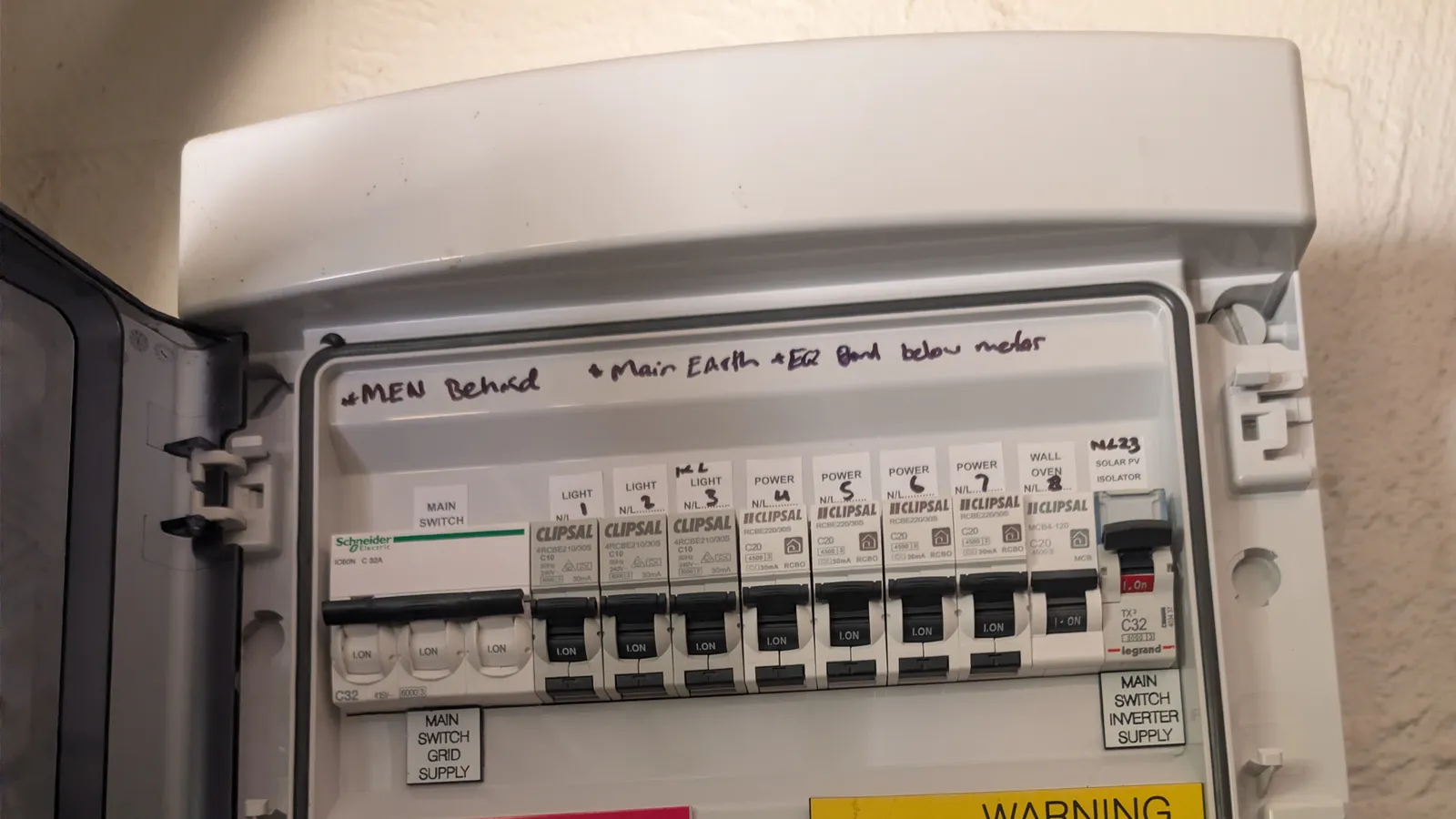
The full board replacement range is wide because it scales with board size. A small 6-circuit board sits at the lower end; a large modern board running ducted AC, EV charging, and 12+ circuits sits at the upper end. A full replacement with RCBOs on every circuit (individual safety-switch + breaker per circuit) is the modern best-practice setup, every circuit has its own dedicated protection so a fault on one doesn’t kill power to the whole house.
The variables that move the price
- Number of circuits, a 6-circuit board is cheaper than a 14-circuit one. Most older Perth homes have 6-10 circuits; modern homes with EV chargers and ducted AC often run to 12-16.
- Single-phase vs three-phase supply, three-phase is always more expensive. The switches, RCDs and breakers are larger and pricier, and the board ends up physically bigger to fit them. If your home has three-phase, expect to pay 30-50% more for the same scope of upgrade compared with a single-phase board.
- Pre-existing wiring faults (crossed neutrals), this is one worth knowing about. Once individual RCDs are installed, any pre-existing wiring fault where neutrals are shared or crossed between circuits will show up as nuisance tripping. The RCDs aren’t the problem, they’re revealing a fault that was already there. Tracking it down and repairing it adds time, and a quote can’t know about it in advance. Worth asking your electrician how they handle this if it comes up.
- Access, a board in a tight garage corner takes longer than a board on an open wall.
- Same-day vs scheduled, emergency or “we’re stuck mid-install” jobs cost more than planned upgrades.
What “full upgrade” should and shouldn’t include
If you’re quoted a “full switchboard upgrade”, ask what’s actually in it. A fair quote should include:
- New enclosure (the box itself).
- New main switch.
- All new breakers (one per circuit).
- At least one RCD covering power circuits, ideally individual RCBOs.
- All required wiring tails and termination work.
- A signed certificate of electrical compliance.
A quote should NOT just be “$2,500 for a new switchboard” with no breakdown. If you can’t tell what you’re getting, you can’t compare it to anything else.
Safety switch vs RCBO vs MCB, what each actually does
A common source of confusion (and overpricing). The three things on a modern board are:
- MCB (Miniature Circuit Breaker), protects against overload and short circuit on one circuit. Trips if too much current flows. This is what most people call “a breaker”.
- RCD (Residual Current Device / safety switch), protects against current leaking to earth (people getting shocked). One RCD usually protects multiple circuits.
- RCBO, both functions in one device. Each circuit gets its own combined RCD + MCB.
The modern best-practice setup is RCBOs on every circuit. It’s more expensive upfront but it means if there’s a fault on (say) the kitchen circuit, only the kitchen loses power, not the whole power side of the house.
The cheaper compromise is a couple of shared RCDs protecting all power circuits and all lighting circuits. This meets the WA legal minimum and is what most older retrofits look like. The downside: any earth-leakage fault kills several circuits at once.
If a quote uses the words “we’ll add a safety switch” without specifying shared RCD vs per-circuit RCBO, ask which. The difference can be $500-$1,000 in either direction.
What a switchboard upgrade in Perth actually involves
A standard board upgrade in an existing Perth home takes a single day, sometimes half a day. No Western Power involvement is required unless the meter side itself is being touched (which is almost never).
On the day:
- Main supply isolated at the board.
- Existing board photographed so we can label every circuit correctly on the new one.
- Old fuses / breakers removed, old tails and bus bars cut out.
- Old enclosure unmounted and the new enclosure mounted.
- New main switch, RCDs / RCBOs, and breakers installed.
- Every circuit tail terminated to the correct new breaker.
- Power restored, every circuit tested, every RCD test-tripped.
- New circuit labels applied so the next sparky who opens the board can see what’s what.
- Compliance certificate signed and submitted.
Power is off for the duration of the work, typically 4-6 hours on the day. We plan the window with you in advance so freezers stay cold and you don’t lose food.
Legal and compliance, when WA actually requires an upgrade
This is the part of the conversation most quotes get wrong. Here’s the simplified version of WA’s rules as they apply to your switchboard:
- At sale, there’s no specific switchboard-modernity requirement. The board needs to be safe and functional. A licensed electrician’s safety report at sale time is sometimes requested by buyers but isn’t legally compulsory state-wide.
- At rental start (new lease), landlords must provide a property with at least two safety switches covering power and lighting, an obligation set out in the WA Electricity Regulations. If the board doesn’t have RCDs, this triggers an upgrade.
- At rental renewal, RCDs must be tested and proven working at the start of each new tenancy.
- During a renovation, if the renovation rewires significant parts of the house, the board needs to be brought up to current standards (AS/NZS 3000:2018, the Wiring Rules).
- When adding a major new circuit, like a ducted AC system or EV charger, the new circuit must meet current standards, and if the existing board can’t accommodate that safely, an upgrade is triggered.
So the most common legitimate triggers are: renting out, renovating, or installing a major appliance. “Selling” alone isn’t one.
How to read a switchboard upgrade quote
Apply this checklist to any quote you receive:
- Is the scope clearly itemised? Enclosure, breakers, RCD/RCBO type, labelling, certificate, all listed separately?
- RCD or RCBO? And how many?
- Is the certificate of electrical compliance included? (It must be, this is what proves the work was done legally.)
- What’s the workmanship warranty? Industry standard is 12 months; we offer 5 years.
- Compliance with AS/NZS 3000? A licensed electrician’s signature on the certificate confirms this, but the quote should confirm it too.
- How are pre-existing wiring faults handled? Worth asking how the electrician handles nuisance tripping if a crossed neutral surfaces after the new RCDs go in.
A customer in Canning Vale showed us two quotes recently. The cheaper one was $1,800 for “switchboard replacement”, one line. Ours, backed by our licensed Perth electrical team, was $2,400 with the breakers, RCBOs, labelling, certificate, and warranty all itemised. The conversation took five minutes, once we walked her through what the cheaper quote was actually delivering (shared RCDs, no per-circuit protection), the comparison was straightforward. She went with us. Cheap quotes look cheap until you check what’s been left off.
Common questions
How long does a switchboard upgrade take?
A standard board upgrade in an existing Perth home is completed in one working day, sometimes half a day. Power is off during the work, typically 4-6 hours.
Can I add a safety switch without replacing the whole board?
Yes, often. If your board has spare DIN-rail space and the existing breakers are reasonable quality, we can retrofit RCDs for around $500. This brings you up to legal compliance without a full board replacement.
How much does a 3-phase switchboard upgrade cost?
Three-phase boards cost 30–50% more than single-phase for the same scope of work, the main switch is bigger, the enclosure is larger, and three-phase RCDs and RCBOs are dearer per unit. Applying that premium to the ranges above: a full three-phase board replacement typically lands around $2,600–$6,000+ depending on circuit count. In practice three-phase jobs skew toward the upper end, because homes with three-phase supply usually have it for a reason, ducted air conditioning, a workshop, or EV charging, and those homes carry more circuits. As with everything else on this page, the only real number is an itemised quote for your specific board.
Will my power need to be off for long?
Plan for 4-6 hours of no power on the day of the upgrade. We schedule the window with you in advance, usually mid-morning to mid-afternoon so freezers stay cold and you don’t lose food.
Do I need to upgrade my switchboard before selling my house?
There’s no WA law forcing you to upgrade. If the board is safe and functional, it can pass through a sale as-is. Some buyers ask for a safety inspection report and that report may recommend upgrades, but it’s a recommendation, not a legal requirement at sale.
Why does my new appliance need its own circuit?
Modern high-draw appliances (ducted AC, EV chargers, induction cooktops, heat pumps) draw enough current that running them off a shared circuit would trip breakers or undersize the wiring. AS/NZS 3000 requires a dedicated circuit for any major appliance, which is why a ducted air conditioning install in Perth often triggers a switchboard upgrade.
Will I get nuisance tripping after the new RCDs go in?
Sometimes, yes. If the existing wiring has a fault where neutrals are crossed between circuits (a common issue in older homes), the new RCDs will pick it up and start tripping. The RCDs aren’t broken, they’re revealing a pre-existing wiring fault that nothing previously detected. Tracking down and fixing the fault is straightforward but adds time to the job, which a quote can’t predict in advance.
What’s the difference between a safety switch and an RCBO?
A safety switch (RCD) protects against earth leakage and usually covers several circuits. An RCBO does the same earth-leakage protection PLUS overload protection on a single circuit, meaning if one circuit faults, only that circuit goes off. RCBOs are the modern best-practice setup; shared RCDs are the older, cheaper compromise.
The bottom line
Switchboard upgrades in Perth cost between $500 and $4,500+ depending on what’s genuinely required. A simple safety-switch retrofit sits around $500, a partial board upgrade around $1,000, and a full board replacement runs $2,000-$4,500+ depending on board size and whether the home is single-phase or three-phase. The upgrade is genuinely needed when you don’t have RCDs, when the board is full, when something is physically damaged, or when WA tenancy/renovation rules trigger it, not just because the board looks old.
The single best protection against overpricing is asking for an itemised quote and understanding what’s in it. Generic “$2,500 to upgrade your switchboard” quotes give you nothing to compare.
Want a real opinion on your existing board?
We’ll come out, open the board, and tell you exactly what’s there, what’s safe, what’s not, and what would actually be worth upgrading versus what can wait. Free and no-obligation.
Get a free Perth switchboard inspection →
If you’ve already got a quote and want a second opinion, send us a photo of your board and we’ll tell you whether the quote is fair before you commit. No charge.
Written by Matt Grossmith, owner of Otter Air & Electrical. Matt holds a WA EW electrical contractor’s licence and has been doing residential switchboard work across Perth for over 10 years.
Need a hand with this?
Otter Air is your local, licensed Perth team for air conditioning and electrical. Free quotes, upfront fixed pricing, and honest advice.